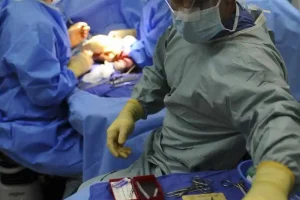
Imagine standing at the edge of a dense, uncharted forest. That’s what a complex surgery can feel like for a surgeon. The traditional map—scans, tests, experience—is helpful, sure. But what if you had a guide who’d walked every possible path a thousand times before? That’s the promise of artificial intelligence in pre-operative planning today. It’s not about replacing the surgeon’s skill; it’s about illuminating the trail.
Honestly, the pre-op phase has always been a high-stakes puzzle. We gather pieces—imaging, lab results, patient history—and try to see the whole picture. But human brains, brilliant as they are, can miss subtle patterns in a sea of data. That’s where AI steps in, not as a cold, calculating robot, but as a meticulous partner. Let’s dive into how this tech is quietly revolutionizing the crucial steps before a patient ever reaches the OR.
From Pixels to Predictions: AI-Powered Surgical Visualization
It starts with seeing better. Traditional 2D scans (CT, MRI) require surgeons to mentally reconstruct 3D anatomy. It’s a skill, but it’s also a guess. AI algorithms can now do this reconstruction automatically—and add layers of intelligence.
These tools segment different tissues: bone, blood vessels, tumors, healthy organs. In seconds. What used to take hours of manual tracing is now done with a click. For a complex liver resection, the AI can color-code the vascular segments, showing the surgeon exactly which vessels feed the tumor and which are safe to cut. It’s like getting a personalized, interactive GPS for the human body.
More Than Just a Pretty Picture
The real magic isn’t just visualization, but simulation. Advanced platforms use this 3D model to run “what-if” scenarios. Want to see how removing a tumor from this angle might affect blood flow to a healthy lobe? The AI can simulate it. This virtual rehearsal space reduces surprises and, frankly, builds surgical confidence. It turns planning from a static review into a dynamic, interactive process.
The Crystal Ball of Risk: AI in Pre-Operative Risk Assessment
Here’s where things get profound. We’ve always assessed risk using scoring systems—helpful, but blunt instruments. They often miss the unique interplay of factors in this specific patient. AI excels at finding these hidden connections.
By analyzing thousands of data points—from past medical records to subtle biomarkers in lab work—AI models can predict individual risks with startling accuracy. Think post-operative complications: infection, cardiac events, prolonged hospital stays. The AI doesn’t just say “high risk.” It might flag that a patient’s specific combination of age, a barely-off electrolyte level, and a past medication creates a 40% higher chance of delirium. That’s actionable intel.
| Traditional Risk Assessment | AI-Enhanced Risk Assessment |
| Relies on a few key variables (age, ASA score). | Analyzes hundreds of intertwined variables from EMR, labs, imaging. |
| Generalized population-based scores. | Personalized, patient-specific risk profiles. |
| Static, one-time evaluation. | Dynamic, can update with new data pre-op. |
| Output: A category (e.g., “Intermediate Risk”). | Output: Probabilistic forecasts for specific complications. |
A Real-World Example: Beating Surgical Site Infections
Some hospitals now use AI that scrubs through pre-op data to predict which patients are most likely to develop a surgical site infection (SSI). It might notice patterns humans consistently overlook—like a specific glucose trend paired with a low albumin level weeks before surgery. Knowing this, the care team can intervene: optimize nutrition, adjust pre-op antibiotics, or even modify the surgical approach. You’re not just predicting the future; you’re changing it.
The Human-AI Collaboration in the Planning Room
Okay, so the machine is smart. But the key word is collaboration. The surgeon’s expertise—their intuition, their tactile knowledge, their experience with the unpredictable—is irreplaceable. AI provides a data-rich second opinion.
Here’s how the dialogue often goes now: The surgeon reviews the AI-generated 3D plan and risk report. They might agree with 95% of it. But they spot a nuance—the AI’s suggested approach gets too close to a nerve bundle based on a past case they remember. They adjust. The plan is better for it. The AI handled the brute-force data analysis; the human provided context and judgment. It’s a true partnership.
Not Just Science Fiction: Current Applications and Real Hurdles
This isn’t all theoretical. AI is actively used in:
- Orthopedics: Planning joint replacements for optimal implant fit and alignment.
- Neurosurgery: Mapping delicate brain pathways to avoid functional areas during tumor removal.
- Cardiac Surgery: Modeling blood flow dynamics to plan coronary bypass grafts.
- Oncology: Defining the precise margins for cancer resections to maximize tissue preservation.
That said, the path isn’t without bumps. There are real challenges. “Black box” algorithms that don’t explain why they made a prediction can erode trust. Data privacy is a massive concern. And integrating these tools into already-clunky hospital workflows? That’s a whole other surgery itself. The tech has to fit the human system, not the other way around.
The Future is Augmented, Not Automated
So where does this leave us? The goal of AI in pre-operative planning isn’t autonomy. It’s augmentation. It’s about giving surgical teams superhuman sight—the ability to see risks hidden in plain data and to walk through an operation before making the first incision.
The best outcome isn’t a flashy robot surgeon. It’s a calmer, more informed surgeon walking into the OR. It’s a patient who gets a personalized plan and a clearer understanding of their unique journey. It’s about making the uncharted forest a little less daunting, one data point at a time. And that, you know, is a future worth planning for.